
Wasps, hornets, bumblebees — we solve the problem without killing.
Wasp, hornet and bumblebee nests removed or relocated, plus honest advice — control only in an emergency. Since 1992 in Northern Germany, now also in Southern Denmark.
✓ Experienced since 1992 ✓ Guarantee ✓ Family business
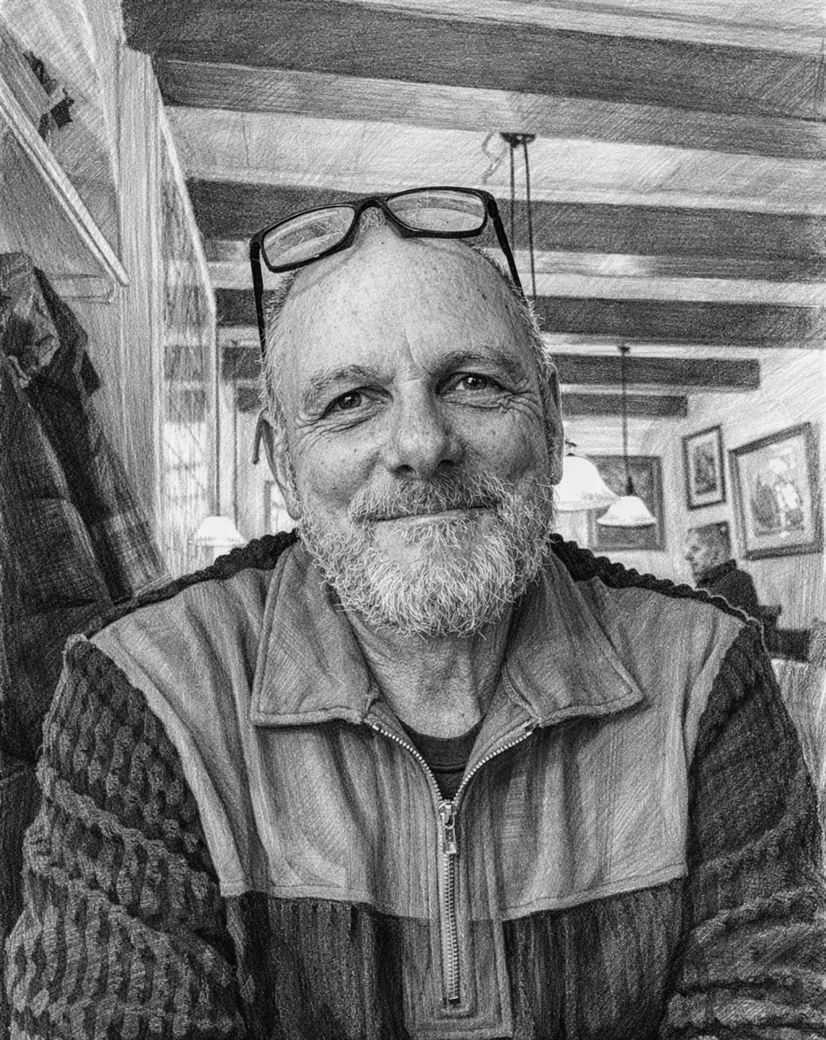

I'm Jürgen Hanika!
For 34 years I've worked with wasps, hornets and bumblebees every day. I founded "The Wasp Experts" out of a simple observation:
Most insects considered "pests" aren't. They're just in the wrong place.
My job: to find the right place — for the nest and for the people living with it.
Today my sons Julian and Merlin are on board too, each with their own company — with locations in Wedel and Schmalfeld near Bad Bramstedt. Together with my locations in Southern Denmark and Handewitt, we cover all of Schleswig-Holstein, Hamburg and Southern Denmark.
Three specialities — nothing else.

Wasps
A wasp nest in the roller-shutter box, under the eaves, in the loft or in the ground: in most cases professional removal or relocation is enough. Killing only when there is no other way.

Hornets
Hornets are strictly protected. We assess each case individually and relocate the hornet nest — never just "get rid of it".

Bumblebees
Bumblebees are strictly protected and are always relocated. We move the bumblebee nest safely to a new location.
Hornet relocation for real
A short glimpse of our work — peacefully relocated instead of killed.
We help — guaranteed.
If we can't help — through removal, relocation, education or advice — it costs you nothing.
Wasps are not pests.
Wasps, hornets and bumblebees are an important part of our ecosystem. They pollinate plants, keep other insects in check, and a wasp colony lives only a few months — by late autumn it dies on its own anyway.
We don't kill. We resolve conflicts.
Most of the time, relocation, a little patience or simple explanation is the better answer than the spray.
The beginning: a queen builds alone.
These pictures show the beginning in spring — when the queen starts a new nest entirely on her own. Only once the first workers hatch do they take over building it further. By late summer the nest then grows to many times this initial size.
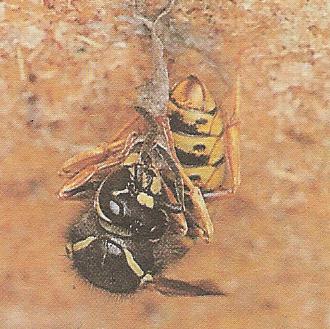
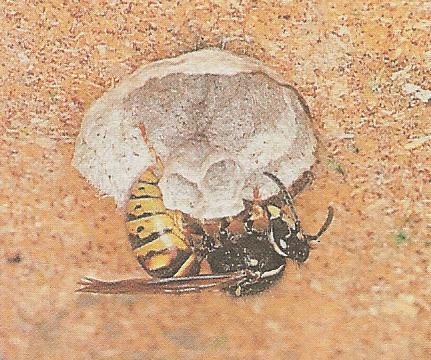
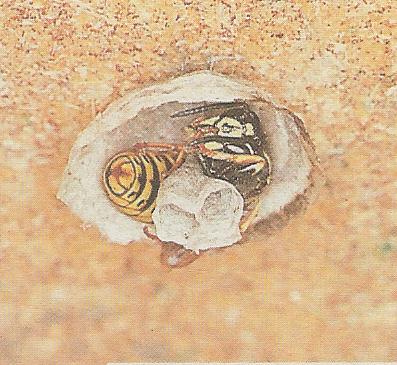
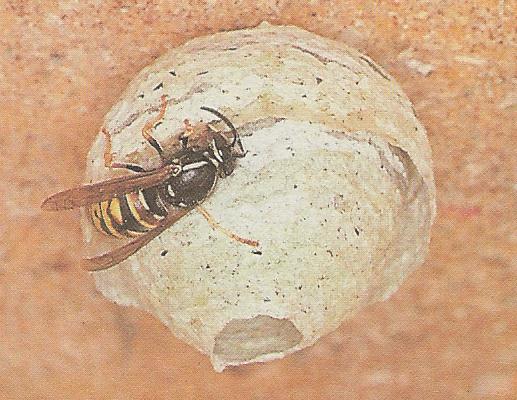
Source: Rolf Witt
Understanding wasps.
Those who know them fear them less. Here are a few basics we're happy to explain — before anyone reaches for the spray.
The life cycle of a long-headed wasp colony
Social wasps (paper wasps) form colonies that live only about half a year. In spring — depending on region and species, from early May — the queen wakes from her winter dormancy and founds a new colony.
Each awakened queen begins entirely alone to build an intricate nest: the first combs from chewed wood, in which she lays the first eggs. The combs open downwards.
Larvae hatch from the eggs and are fed with prey — mainly insects. After about two weeks they spin a silk lid over their cell and pupate. Another two weeks later the first workers (sterile females) hatch and take over building the nest. After that the queen only lays eggs.
Depending on the species, the colony raises males and new queens between June and August. Worker production stops. In August the colony reaches its peak.
Then the dying begins: lack of food and falling temperatures mean that between early September and mid-October all the wasps have died — including the old queen. Only the young, mated queens remain.
They look for a place to overwinter (cracks, holes in the ground, dead wood) and found a new colony the following spring. But: only about one in ten queens survives the winter and manages to found a nest.
Long-headed wasps — the peaceful ones
Long-headed wasps have no interest in sweets or barbecue meat. They don't buzz around the coffee table — if you see one, it's usually not a problem.
Their nests hang freely, often in bushes, hedges or ivy. Ochre-coloured in the median wasp, grey and conical in other species, with one or two entry holes at the tip. They also build them in attics, sheds or under overhangs.
Diameter about 25 cm, up to 200 animals. Life cycle: end of April to early/mid-September. The only sweet food they eat is windfall fruit.
Short-headed wasps — the "nuisances"
When someone says "the wasps are aggressive today", they almost always mean these two species: German wasp (Vespula germanica) and Common wasp (Vespula vulgaris).
These colonies can number up to 10,000 and considerably more animals — and in warm spots inside the house, nests survive into November, and because of the increasingly mild winters even into January.
A common phenomenon in winter: individual wasps find hiding places in stacked firewood. When the wood is brought into the warm living room, the warmth wakes the animals — and suddenly a wasp is flying through the room in the middle of winter.
What brings them to the coffee table and barbecue: for the brood they need protein (hence the interest in sausage and meat), and for their demanding hunting they need quick fuel (hence the craving for sugar in August/September).
They like to build their nests in the ground (hence "ground wasps"), or hidden behind cladding or in the roof. Often you can only spot them by the air traffic at the entry hole.
How it works.
Send a photo
Via WhatsApp (DE) or SMS/Messenger (DK). That lets us see the species and location.
Fixed price
Usually within a few hours, often immediately.
Appointment
Usually 1–3 days. Urgent cases the same day.
Done
Clean, safe, with a short explanation of what we did and why.
Where we work
We're at home in the border region — on both sides. In Denmark all of Sønderjylland, in Germany the north of Schleswig-Holstein.
Denmark — Sønderjylland
From Rømø on the west coast to the east coast — including Tønder, Løgumkloster, Skærbæk, Bredebro, Højer, Toftlund, Aabenraa, Rødekro, Padborg, Kruså, Gråsten, Sønderborg, Nordborg, Augustenborg, Haderslev, Vojens and Christiansfeld.
Our base: Skolegade 27, 6240 Øster Højst — in the middle of Tønder Kommune.
Germany — North Frisia & Schleswig-Flensburg
From Flensburg to Sylt and down to Eckernförde — including Handewitt, Harrislee, Glücksburg, Niebüll, Leck, Süderlügum, Husum, Schleswig, Kappeln and Westerland.
Further south (Hamburg, central Holstein) my sons take over with their own companies.
Your town not listed? Call anyway — for jobs further away we usually combine several nests into one tour.
Frequently asked questions
How quickly can you come?
Usually within 1–3 days. In urgent cases — a nest right by the front door, wasps inside the home, an allergy sufferer in the household — we try to come the same day. Best to send us a photo, then we'll tell you straight away what's possible.
Is it dangerous for my children or pets?
No. With a relocation there are no chemical residues — we simply move the nest to a new place. If in rare cases control is necessary, we'll tell you exactly how long to avoid the area beforehand. Usually a few hours, no more.
What exactly does it cost?
A standard wasp nest costs 160 € (1,250 DKK) as a fixed price — including travel, materials and labour. Hornets and bumblebees are more individual (permits, location, effort), so you get your fixed price after a photo and a brief chat. No hidden costs, no surprises.
Do I have to be home?
Not necessarily. If we can reach the nest without going through your home, we'll do it in your absence too. You briefly describe the access; payment and documentation follow afterwards by phone or email.
Why don't you just kill them? That's faster, isn't it?
Because wasps, hornets and bumblebees are not pests. They are important pollinators and natural pest regulators — without them we're all worse off. Hornets and bumblebees are also strictly protected by law; killing them is a criminal offence. We only resort to control when there really is no other way. Most of the time there is another way — and it's no more expensive.
Aren't hornets dangerous?
No — quite the opposite. Hornets are far more peaceful than ordinary wasps. They avoid people, have no interest in cake or soft drinks, and their sting is no more toxic than a honeybee's. The bad reputation comes from old stories, not from reality. Even so: a hornet nest right by the front door or a child's bedroom window we're happy to relocate.
Do you really get every nest out?
In the vast majority of cases, yes — even in roller-shutter boxes, roof structures, holes in the ground or hard-to-reach spots. In the rare cases where it's technically impossible, we say so openly and advise you free of charge on what else you can do. That's part of our guarantee: we help — or it costs nothing.
Do you come in the evening or at weekends too?
Yes. We're not a 9-to-5 company — wasp panic rarely happens during office hours. Just call. If we're working on another nest, we'll get back to you as quickly as possible.
Where do you work — service area?
The whole border region: in Denmark Sønderjylland, from Rømø on the west coast to the east coast. In Germany northern Schleswig-Holstein — Schleswig-Flensburg and North Frisia (Flensburg to Sylt) and down to Eckernförde.
In the nearer area we usually come spontaneously. Further away (towards Eckernförde, for example) we often put together a tour with several jobs — so there may be short waiting times. Just let us know, we'll find a solution.
What happens to the nest after relocation?
We take it to a suitable new location, far from people — hornets typically into nest boxes on trees, bumblebees to a sheltered spot in the ground, wasps similarly. There the colony has the chance to complete its annual cycle normally. By late autumn the colony dies on its own anyway — only the young queens overwinter and found new colonies the following year.
Pay with MobilePay

You can conveniently pay with MobilePay — the common payment method in Denmark. Scan the QR code with your phone or tap the button to open the MobilePay app directly.
You enter the amount in the app yourself — as agreed.
Contact & Booking
Tell us briefly what's going on — we usually get back to you within 24 hours.